This form supports two types of query: you can enter a complex boolean
expression that precisely defines the species distribution of families
that you want, such as "Caenorhabditis elegans AND NOT Homo
sapiens", or you can check the "Find domains unique to
query term" box and enter a single taxonomic descriptor, e.g.
"apicomplexa" to find all Pfam-A families that are
unique to that particular level.
More...
Species names
In order to find species names in our database, you must give the full,
unabbreviated name in your query. For example, if you want to find
families in Caenorhabditis elegans, you must spell out
"Caenorhabditis"; "C. elegans" does not exist in
the species database and will not return any results. The capitalisation
of your query does not affect the results:
"Caenorhabditis" is the same as
"caenorhabditis".
Term suggestions
Because species names can be long, complex and easily misspelt, the
form will offer suggestions for possible completions of terms that you
enter. For example, as you start typing c-a-e-n, a drop-down panel will
appear, showing the possible completions:

As you enter more letters, the suggestions will be refined accordingly:
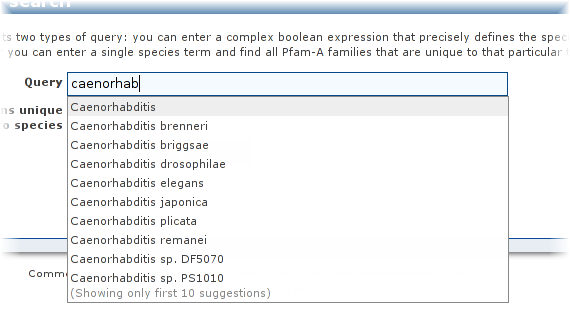
Note that only the last term in the field is used to offer completions,
so if you have already entered "caenorhabditis elegans", going
back and shortening the first word to give "caen elegans"
will not give any suggestions.
Boolean queries
Boolean queries can contain logical operators, such as AND, NOT and OR,
combined with braces ("(" and ")") to form a
description of a set of families with a particular species distribution.
For example, the following query:
Caenorhabditis elegans AND NOT Homo sapiens
will retrieve all families which are found in C. elegans but not
in human, whilst
Caenorhabditis elegans AND Caenorhabditis briggsae AND NOT Homo
sapiens
will retrieve all families which are found in both C. elegans
and C. briggsae but not in human, and
( Caenorhabditis elegans OR Caenorhabditis briggsae ) AND NOT Homo
sapiens
will retrieve families that are found in either C. elegans
or C. briggsae but not in human.
Families unique to a single species
By checking the box marked "Find domains unique to query term"
you can limit the query to finding those domains which are found only
in a single species or taxonomic level. For example, checking the box
and entering "Caenorhabditis elegans" will return a list of
Pfam-A domains that are present only in C. elegans, whilst
"metazoa" will find families that exist in metazoans.
Note that you can only enter a single species term when looking for
unique sequences. You will see an error message if the search field
contains more than one species.